
The poet who used words as the Surrealists used them: to provoke, to disorient, to change life. The following short tributes are devoted to the memory of two good friends of mine, both fellow members of the Liberation Poetry Collective, who passed away recently: Danielle Legros-Georges (February 11, 2025), and Everett Hoagland (July 5, 2025).
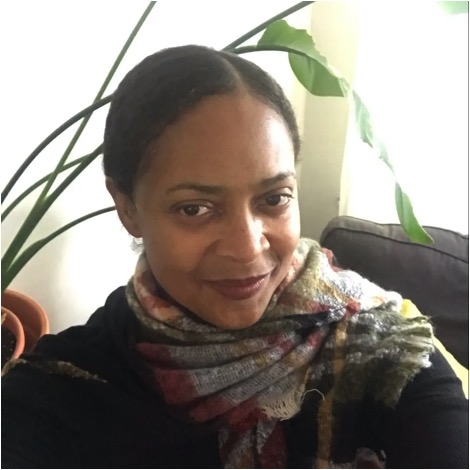
Danielle Legros Georges (Feb. 14, 1964–Feb. 11, 2025)
The great Haitian-American poet, professor and public intellectual, Danielle Legros Georges, passed on Tuesday, February 11 at the age of 60, following a long cancer diagnosis. Since I first met her 30 years ago through the foundation of the Haitian Artists Assembly of Massachusetts, she was a constant, vibrant presence in both the Haitian diaspora community and in the literary life of Greater Boston and beyond.
Danielle was such a great soul. She embodied the qualities that make poetry such a creative and existential force. Chief among them, the magic of words; her playfulness with idioms, her snappy eloquence, and her awareness of History’s malfeasance. Her first major collection of poems,Maroon, published with the left-leaning, independent publishing house Curbstone Press in 2001, is a testimony to that side of her identity. I am certain that had she lived past February 2025, she would have used her poetic gifts to condemn the regime of cruelty and contempt for the law that is taking shape today in this country of us all.
While wholly part of the Haitian community, “Danielle’s strength,” to quote my wife Jill, has been her skill in reaching out and forging ties across various communities, connecting with others with a gentle, poetic confidence” When Legros Georges was named Poet Laureate of Boston, many of us felt great pride for her projecting so beautifully the positive image of the “other Haiti, “the one made of poetry, sharing, cultivation of the soul, solidarity with others. As an homage to her legacy, the newly inaugurated Toussaint Louverture Center in Boston has dedicated a reading room in Danielle Legros Georges’ name, filled by her personal book collection that she donated to the Center a few days before her death.
In a review of her book, Maroon,1 in the magazine Tanbou in 2001, I wrote of how impressed I was by what I called the “sophisticated mastery of the English language “by Danielle Legros Georges, warning the readers that if they found some parts of the book difficult to read “it is because Legros Georges’ writing has a dimension which she uses deliberately to confuse [the reader]. “I wrote that the more I delved into the book, the more stunned I was “by the whirlwind of words—sweet words, bitter words, sharp words—that the book throws at them. “I wrote that she uses words to maroon herself, “because words for her are a ritual for revealing the truth without saying it. “I took for example the poem “Anacaona” where it is not until the end of the poem that one realizes, without her ever saying it, that the poet calls for “revolutionary revenge to right the wrong of Anacaona’s murder by the Spanish Conquistadors.” I cited this passage:
and my name will sow maize
my name will breed vision
my girls will be black, bronzed,
their eyes will be storms
I could have quoted also these passages:
despite my body’s death
in double cross
(by a Spanish gentleman’s deal:
the sword / the crucifix)
despite divisions of time
of tribes
Taino
Carib...
the island’s body itself
its zones:
Marien
Magua
Maguana
Higuey
Xaragua
engulfed
transfigured
my own children
scattered.
I ended the review with the observation, talking again of words, that “Danielle Legros Georges uses words as the Surrealists used them: to provoke, to disorient, and to change life, as Rimbaud would say. She uses words mainly to play with... (…) like the keys of a piano that you tap to see how they sound or a ball that you kick to see where it goes.”2
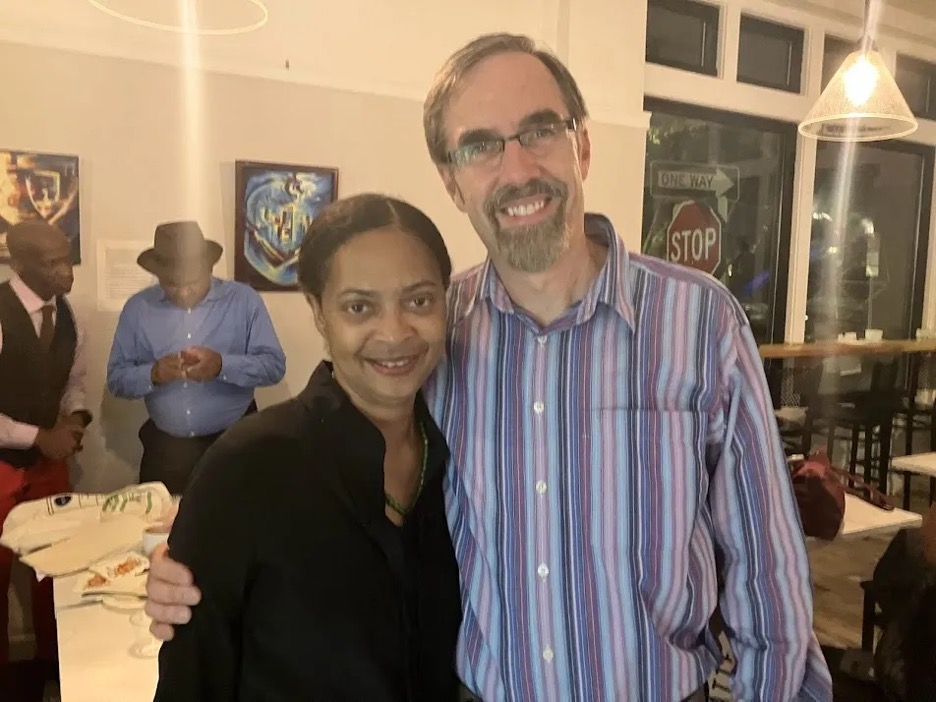
Danielle with Tom Laughlin. Jean-Dany Joachim and Indran Amirthanayaga are in the background.
I feel privileged to have spent time with her and her friend and former professor, the French-Senegalese-American author Sylvie Kandé, during the duo’s two readings at Cambridge’s Grolier Poetry Bookshop and the Brookline Booksmith in May and November of 2022. I felt I was part of something special, as if I were in the presence of goddesses. In a review of these readings that I wrote subsequently, there’s a sentence that has now for me a celestial quality: “There are moments in everyday life when imaginative reverie joins with actual, factually proven occurrence of reality, to stir the senses, creating another, different level of both reality and the means to apprehend it. Poets and poetry often do that, as attested by Latin America’s magical realism. Seeing Danielle and Sylvie together—both of them emanating from the three sides of the enslaving trade triangle, yet embracing the world not solely as warring enclaves of alienation, but as communicable experiences to share—gave to me a sense of kinship with the extraordinary historical events they relate.”3
I miss Danielle Legros Georges a lot as a friend and a fellow poet; passing by her house after her death, I felt that fate was unfair and heartless in depriving us of such a great human being. Along with her friendship and the immanent quality of her poetry, I have especially cherished Danielle’s generosity with her time. Despite her multiple commitments as Boston Poet Laureate and university professor, she unfailingly participated or showed up for every invitation I extended, were it to read at a poetry event or contribute to an anthology (the latest to date is her contribution to This Land, My Beloved: A Trilingual Anthology of Haitian Contemporary Poetry (Trilingual Press, 2023). She contributed not only her own work, but also enriched this volume with works by other poets, including translations of her uncle’s work, the great Haitian guru and poet Jean-Claude Martineau.
For me and for the many who loved her, her work, and her impact on the world, Danielle Legros Georges’ passing is a terrible loss. Our entire community feels devastated by it, but, as another great Haitian poet, Michele Marcelin Voltaire, has said upon learning of DLG’s death, “thankfully she leaves us poetry, which is eternal
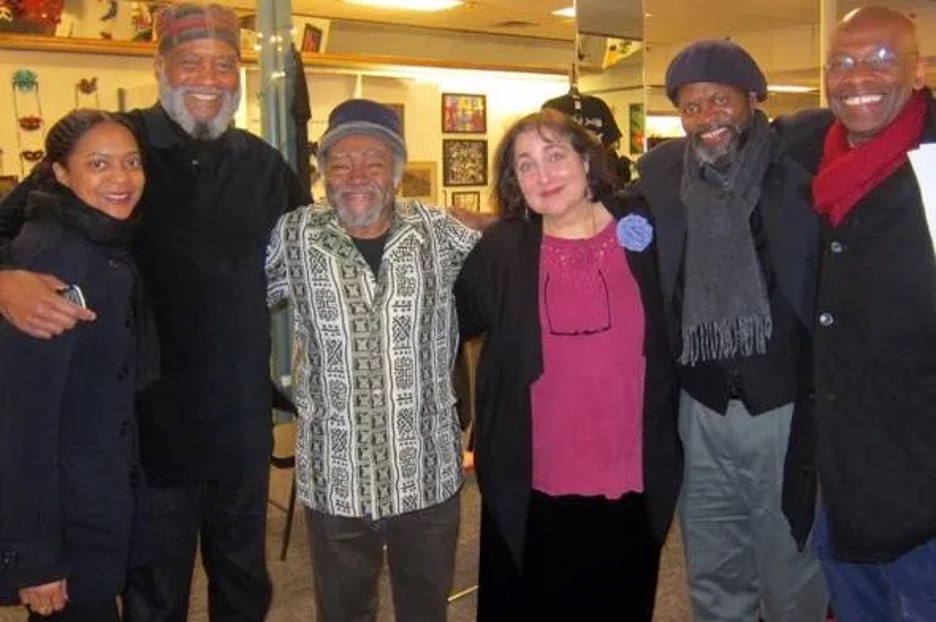
From the left: Danielle Legros Georges, Everett Hoagland, Askia Touré, Jill Netchinsky, Tontongi & Michel DeGraff in a poetry reading at the Out of the Blue Too Gallery in Cambridge, Massachusetts, in 2013.
The Massachusetts Haitian community in its entirety was devastated by the news of Danielle Legros Georges’ passing. Some of her friends, including Doumafis Lafontan, Patrick Sylvain, Carline Désiré, Oreste Joseph, Jean-Dany Joachim, Lunine Pierre-Jerôme, Fritz Ducheine, this author, and many others, participated in televised forums, public remembrances, poetic readings, etc., to honor her memory. It’s telling—telling of her profound connection to her community—that two of her last public readings were with her close friends Patrick Sylvain and Charlot Lucien during the launching of her last published book, Three Leaves, Three Roots.4
In a collective reading on June 10, 2025, at the Boston Public Library for the launching of her new, posthumous book—Acts of Resistance to New England Slavery by Africans Themselves in New England—published by Staircase Books, many writers in the Greater Boston area came to pay a final homage to her memory and her contribution. Among those reciting her poems were Jennifer Barber, Toni Bee, Martha Collins, Erica Funkhouser, Gerard Georges, Tatiana Johnson-Boria, Tom Laughlin, Emmanuel Oppong-Yeboah, Patrick Sylvain, this writer, in collaboration with the Boston Public Library and the Boston Mayor’s Office of Arts and Culture.
I must also salute the greatness of soul of her partner Tom Laughlin, a fellow poet, who sturdily provided Danielle the love, the anchor and the moral support to sustain her last days among us, along with her brother Gerard Georges and the rest of her family.
May Danielle Legros Georges’ memory and legacy continue to enlighten our world, and teach us lessons of awareness, authenticity and, most of all, the moral imperative of the social function of poetry.
Notes
| 1. | Danielle Legros Georges, Maroon, Curbstone Press, Willimantic, CT, 2001. The title refers to the name given to the fugitive enslaved of Saint Domingue who fled the plantations to organize their own enclaves of resistance. |
| 2. | Magazine Tanbou, summer 2003 |
| 3. | The entire review can be read here: https://www.tanbou.com/2022/Sylvie-Kande-Danielle-Legros-Georges-reading.htm |
| 4. | Danielle Legros Georges, Three Leaves, Three Roots (Poems on the Haiti-Congo Story), Beacon Press, Boston, 2025 |
Homage to Two Poetic Titans
Brother Everett Hoagland: the Lion in Winter
Something stronger in my inner self compelled me to take the long, almost 3-hour drive, from my house to New Bedford, to attend the memorial service for my friend Everett Hoagland. Something in me wanted me to “pay him back” for the sacrifice to which he consented, already in his seventies, when he drove almost three hours to come to our meetings in Cambridge during the preparation and the editing process of the anthology Liberation Poetry: An Anthology.1
It was in the context of the activities of the Liberation Poetry Collective, a literary group we founded in 2001, that I met Brother Everett. A close friend to legendary Black Arts poet Askia Touré, who invited him to join the LPC, Everett Hoagland soon became an influential and venerated member of our collective. Like many other members of the group, which at one point included cultural giants such as Askia himself, Aldo Tambellini, Brenda Walcott, Gary Hicks, Jack Hirschman, Paul Laraque, and others, Everett Hoagland came with a long history in the use of poetry as liberational praxis. His poetry took its shape and inspiration from the civil rights struggles of the 1960s and 1970s, becoming one of the proponents of the Black Arts movement. Hoagland’s work continued to evolve to encompass the more recent period of the Black Lives Matter movement.
Though by his corporal composure, his knowledge of History, his linguistic eloquence, and classical intellectual formation, one could easily mistake him for Black royalty or a patrician, Brother Everett had a very popular, down-to-earth aspect, and a deep commitment to social justice. I liked him and was drawn to him the very first time I met him. He was a genuinely liberated Black liberator.
As we can see in the poems he submitted for the Liberation Poetry Anthology, Hoagland’s poetry is a cry of rebellion often manifested in direct attack against the unjust political system, other times in elliptic, allusional verses:
We must salvage the shards
of truth and light in our minds beyond
sorely cratered jingoism at Ground Zero,
.................................................................
there shall be no
inhumanity
in any nation’s world
or domestic policies.
That again and again,
we humans must try
to be humane. Or we will go
down into the unlit pit,
the black hole of hate
at Ground Zero
into which so much
and so many—different
times and places—have already fallen.
[“‘From Ground Zero,” in Anthology of Liberation Poetry, 2011]
Hoagland’s poetry or poetic interest, however, is not just about political struggle, as attested by his editing of the Anthology of Ocean Poems. All three poems he contributed to that anthology (At Around Hill Beach, Celebration, and As I Ebb Toward the End of Life) are related to ocean or water, but Hoagland finds a way to connect them to the human historical experience:
Lest we forget,
every Fourth of July
I want some country, some-
one to send a replica of one of all
those slave ships over the Middle
Passage to the tall ship parade—
to keep it honest, to make it real, to see...
.................................................................
A tide of blood recedes
exposing skeletons
and hand-carved bone crosses
pressed in the middle of Bibles
and history books.
[Celebration, in Anthology of Ocean Poems, 2013] As a child at the shore
I was assured by my grown-ups
that if I held any sand-and-water-worn conch
shell to my ear, I would hear the sea.
And I did, or so it seemed to me.
weather driftwood
at the shore, watching
my frolicking young grandsons ply
in tide pools, and plash in the surf, and splash
sea water on one another, whenever I hold a spiral
remnant of a conch shell to my good ear, I hear nothing
but the ocean’s measured music,
its crescendos, diminuendos,
and my grandboys’
healthy, joyful
laughter.2
[As I Ebb Toward the End of Life, in Anthology of Ocean Poems, 2013] In my own poem for that anthology, I evoked the figure of the Haitian Vodou lwa Simbi. She reigns in water, present along rivers or in the ocean. She is unpredictable and her encounter is life-changing:Simbi-in-the-Water
elegant, majestic, beautiful
rarely strikes in someone’s lifetime
then when the bell rings often out of the blue
in whirlwind occurrence the sacrifice must be total
new way of being must be invented
a new sub-oceanic consciousness
has now made the rounds of our humankind
Agwe and Simbi and Humans
together sharing forbidden lost space
in the ocean’s depth, enjoying life’s vibes
and joining together to create new energy,
new elation, creation, cosmic renewal...[Simbi in the Water, in Anthology of Ocean Poems, 2013]
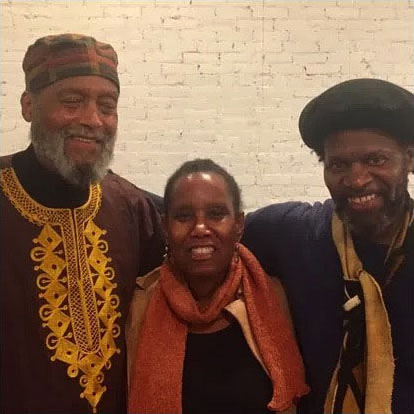
From the left: Everett Hoagland, Soul Brown & Tontongi at a poetry reading in Cambridge, Massachusetts in 2015.
My best memory of Everett Hoagland is when, in January 2014, we (Askia Touré, Tony Van der Meer, Everett Hoagland and I drove together from Boston to the funeral of literary great Amiri Baraka, in Newark, New Jersey. We had a great time, talking about everything, from politics to the latest gossip in the US literary world. I felt honored when he was kind enough to invite me to contribute a poem to Ocean Voices, An Anthology of Ocean Poems that he edited in 2013. Another fond memory of Everett Hoagland stems from the first Trump administration, amid the latter’s apparent sympathy for white supremacy, starting with Trump’s refusal to condemn the neo-Nazi rally in Charlottesville, Virginia, in 2017, saying there were fine and good people on both sides; a moment where Trump openly encouraged killings of Black people by the police, demeaning the Black Lives Matter demonstrators who protested such killings; a moment and context when the same Trump called Haiti and countries of Africa “shithole countries,” etc. It was in the context of all of that, amidst that dire perspective for race relations in the United States, that I called Brother Everett Hoagland.Expecting a response that would corroborate my somber outlook, Everett said simply: “Everything, History itself, is relative, Brother Tontongi. There was a time in the 1920s when the Ku Klux Klan paraded in the open in Washington DC, and in Madison Square Garden in New York City.” That was his way of saying that the reactionary, extremist and fascistic current state of affairs in the United States should not mask the reality that the country has overcome other outlandish and barbarian stages of its evolutionary history, that Trumpism is only one of those impulses toward the most atavistic, inhumane and self-aggrandizing instincts of the country, and that we will overcome it as well. A fervent proponent of poetry as equal participant in the struggle to change life, Everett Hoagland remained until the end a strong poetic voice for political justice, a voice that keeps alive the dreams of the ancestors.In a eulogy by Jack Spillane in the newspaper New Bedford Light titled “Everett Hoagland’s Voice Called for Our Best Selves,” the author called the former Poet Laureate of New Bedford “the lion in winter” who writes “iconic ‘truth to power’ poems in which for decades he had deconstructed the false myths surrounding U.S. American history. (...) An important voice in the Black Arts Movement of the 1960s and 1970s, Hoagland’s work was respected by such important African American literary figures as Sonia Sanchez, Nikki Giovanni and Maya Angelou. Angelou described him as ‘someone who cares and someone who comprehends.’ He had been inspired and mentored by none other than Langston Hughes himself.3 At Everett Hoagland’s memorial and celebration of life held on July 31, 2025 at the New Bedford First Unitarian Church, the New Bedford multi-ethnic community, along with many cultural personalities of Greater Boston, bore witness to their grief and love for this literary giant, among them Erik Andrade, his close collaborator of 25 years, and many others that included poets Regie Gibson, recently named first Poet Laureate of the state of Massachusetts, Martin Espada, Tony Van Der Meer, this author, and many others. As I honor the memory of these two great poets—Danielle Legros Georges and Everett Hoagland—I remind myself that poetry exists, in part, to provide us some sustaining solace to fill the absence of our departed griots.
—Eddy Toussaint Tontongi
Notes
| 1. | Liberation Poetry: An Anthology, edited by Tontongi and Jill Netchinsky, Trilingual Press and LPC. Cambridge, MA, 2011. |
| 2. | Everett Hoagland, Ocean Voices : Anthology of Ocean Poems, Spinner Publications, 2013. |
| 3. | Jack Spillane, “Remembering Everett Hoagland, New Bedford’s first poet laureate, “New Bedford Light, July 8, 2025. |