
I invite the reader to read the following poems as they would read an anthropological field report: absorbing elements that are both familiar and strange, both rational and trapped in unreality.
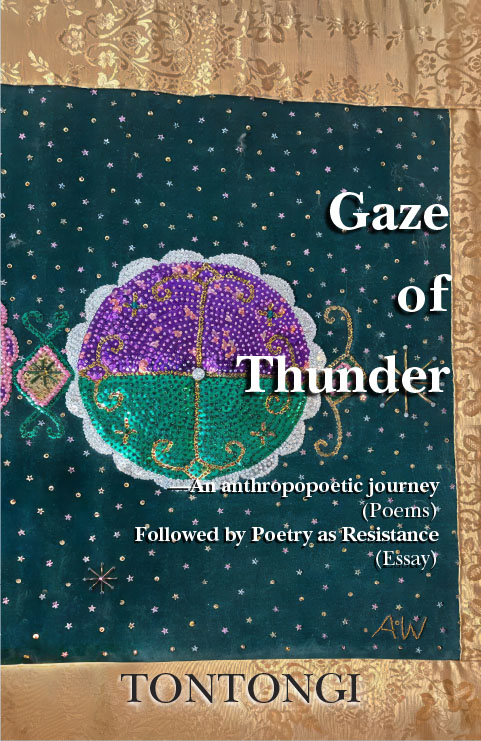
The front cover of Gaze of Thunder.
These poems are both testimonials to my living at a certain time and in a certain place in the United States of America, sort of snatch-short memories of fugitive instants, as well as long-term aspirations and dreams for a better world. The book consists of four parts: the first features poems that codify memories of the Trump candidacy and administration from the years 2016 to 2021 (each instant feeling like an eternity). Those poems also encompass the heroic and persevering resistance the people mounted to counter the nightmare.
The second part lays out a series of short, conceptual poems and texts, impregnated with philosophical insights and lyrical reasoning that mix prosaic form and poetic symphony. This part captures what I call the fugitive moments, those that come à l’improviste, unexpectedly, in the contingence of everyday living, in the slow passing of time. The poems in the first part, as well in the second, can deservedly be construed in phenomenological fashion as a kind of anthropological poetics or anthropopoetics, evidentiary revelation of my being-there in the United States in that particular moment. Being there at the moment when History is being written, being there as part of a complex world within the USA. Being there in this particular juncture and conjuncture provides me with a huge source of material and intellectual sustenance, despite the many obvious, underlying stressors and apprehensions attached.
The third part includes poems conceived and composed during the Covid-19 pandemic, offering a window into my affect of the time. How could a poet live those dreadful and macabre moments and not put down something on paper? The same is true for the fourth (and last) part of the book: How could I live the genocidal horrors of the Israeli-Palestinian conflict and not put down something on paper
Having lived most of my adult life in exile in Northern countries, my essays and poems are both anthropological data and lyrical testimonials. Only this time the anthropology is reversed: instead of the colonizer looking at the colonized as object, it is the colonized who is now looking at the colonizer (or the inheritor of the colonizer )—perhaps not as object but as anthropological interest. For once the North is being scrutinized by a gaze that is, as Frantz Fanon would say, “a conscience of itself,” and not a reflection of its own megalomania.
The three prose essays of the Epilogue—“The Bull and the Red Cape,” “On Anticipatory Obedience,” and “Poetry as Resistance”—constitute an effort to share with the readers additional observations on contemporary events and problematics. It’s clear that the arrival of the openly authoritarian and white supremacy-friendly Trump administration has redefined the risks of political dissent in the United States, which had hitherto fashioned itself as a beacon of intellectual freedom.
In reality, the gangsterish and nihilistic nature of the Trump regime makes it difficult to assign a rational directive to its practices beyond the incentives of greed, hate and power. Political institutions and norms are valid only if there are actual human beings willing to observe and apply them. It also means, willing to defend them, to remind others of their relevance.
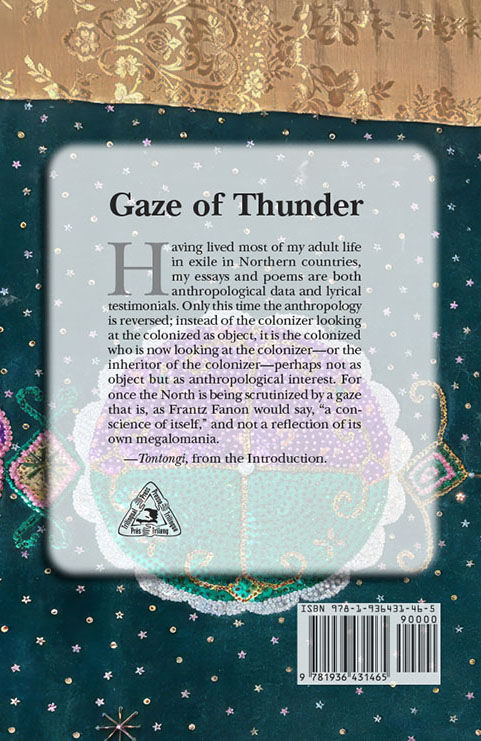
The back cover of Gaze of Thunder.
This has been my main surprise observing the reaction of the US political class to the unrelenting onslaught of the Trump administration against what the French call l’État de droit, literally the State of law, the rule of law, the foundation of the US civilization, even in its imperfection. Poets, philosophers, artists are emotional people, they react badly to bullshit, to the mafia boss telling them black is yellow, and that what they see with their own eyes is only an illusion, a manipulation of the Deep State. They incarnate the light in the tunnel of cowardice; they represent courage.
I always knew that people put their own interest, meaning what they perceive as the empirical conditions of their survival, as overriding. Seeing, however, elected officials and highly educated State functionaries succumb to the whim of an irrational and ideologically deranged leader makes me sad. I am surprised by the rarity of people in positions of power in the institutions targeted by Trump who show open opposition to his misdeeds and demands. I presume their rationale to be as follows: we may be great citizens, imbued with civic etiquette, but we still have to pay our mortgage or our children’s school tuition. Such reflexes make them vulnerable to bullying and intimidation at a time when dissent is painted as treason by the Trumpian orthodoxy.
If you watch US television and cable news, you may notice a refusal to name the monster for what it is. “Naming is changing,” said French philosopher Jean-Paul Sartre, because naming the thing for what it really is, designating it for what it represents, is already a huge part in the process of change. The US media have acted, for the most part, as if Donald Trump were a normal president (or candidate before that). Where he should have been painted as a threat to national civic coherence, he was held as simply an eccentric politician. The ensuing damages to US stability and international standing are immense. The question is: Would the people acquiesce to the new, authoritarian, fascist order that Trump offers or would they hold the torch of dissent and freedom in the tradition of Tom Paine?
At the time of the publication of this book in October 2025, the country doesn’t know where it’s heading. The cruelty, the indifference to inflicting pain and suffering, and the exclusion of the Other as official discourse, augur a dark time with no visible end. This feeling is all the more pervasive and overwhelming given that the decisive levers of the national State—the presidency, both chambers of Congress, the Supreme Court—are currently controlled by the Republicans.1
Trump’s recent actions only reinforce the sense of doom felt by the population. Dartmouth University political scientist Sean Westwood captures it well: “What we are witnessing,” he says, “is not yet a war, but it is far more than mere political division. It is a systematic terror campaign on institutional legitimacy. The president is brilliantly weaponizing the animosity cultivated in the electorate over the past 40 years (…) The conflict is no longer defined by the distance between the left and right, but by the state-sanctioned assault on the norms, laws and institutions that guarantee a liberal society.”2
In this dire moment, the only consolation are the lessons from this country’s history, the awareness of how far it has come, the many devilish moments it had overcome. I am indeed hopeful for the survival of intellectual and political freedom in both the United States and Haiti because I know that oppressive and authoritarian regimes don’t last forever even though they may carry on for a long time. Despite the Roman and French centuries-old imperial control of large swaths of the world encompassing many continents; despite Hitler’s millenary white supremacy ambition (and the enormous military means allocated for its implementation), the people under seemingly insurmountable control eventually overthrow, through persistent resistance, the hegemonic forces that were oppressing them. It’s a kind of law of Nature.
Notes
| 1. | The municipal and gubernatorial elections of November 4, 2025, brought some hope to the Democrats, especially their wins in the New Jersey and Virginia gubernatorial elections, as well as the unexpected election of Mamdani as Mayor of New York City. |
| 2. | Thomas B. Edsall “Trump Is Not Afraid of Civil War. Neither Is Stephen Miller,” The New York Times, October 7, 2025. |
EXCERPTS
The Children at Aganman’s Gate 1
Horrified and crying
in sudden appearance
at Aganman’s gate
the children take refuge
in their tears
to appease their sadness.
They were told that the long journey
toward the vast Unknown
while not made of roses
would end in a marvelous feast.
The children didn’t know a thing
about Versailles, Berlin, Hiroshima,
and not even nearby Guantánamo
even less about Afghanistan,
Iraq or Syria, Gehenna enclaves
where the killers’ dance has no end.
The children were told at the end
their amiable Uncle from the North
would be there with his charming
embrace to welcome them with joy;
they didn’t know that our world
could be such a mean place.
They did not know that Auschwitz
would be less of a memory
than a continual menace
to those still dreaming of freedom.
They could not know,
that the parental warmth
experienced until then
would be ending so soon.
The children’s cry is the cry of silence
made recluse behind closed doors;
they’re sending us echoes of the kind
of pain felt when giving life to them;
their cry exposed what was supposed
to be faded away incognito,
in the never-happened ethereal world.
Their cry is a verdict
against pretending otherwise,
their cry compels us to ask
what happened to Mom and Dad,
and how come they are not there with them?
Why their voice is not heard
by those with such power to hurt?
Their cry implores us to inquire
about what happened to their childhood,
to their innocence once made sacrosanct
in moral manuals sold to the converted?
How come their land turned out to be yours
and the Rio Grande where their ancestors
washed their clothes are still awash in blood?
The children didn’t know that
the land was never yours from the start;
they didn’t know that it could ever exist
among us such a glacial universe
nor if the Sun would for sure
escape climate change.
The children didn’t know that
you made it possible to mass arrest
thousands of people in one day
and cage them and their children
like animals farm in hellish,
tender-age concentration camps?
How could the children know
that hatred and killing
are being normalized
since five hundreds years ago?
The children didn’t know
that silence is consent in disguise
and that the process is made
to be heartless as an angry shark;
they didn’t know that, how could they?
The children didn’t anticipate
that horrors would be part of the scene,
they didn’t know that you wanted
an unjust society as your spoil.
The children didn’t know we could be
such willing and consensual sheep
to this emotionless specter that threatens
our lives through cultivation of our greed.
The children didn’t know we can also
elevate our moments of togetherness
toward aspirations and positive energies
that enhance the everyday meaning of living.
The children didn’t know
—how could they?—
that assholes exist everywhere
and that if we fight for what is right
there’s a chance to make a difference.
(June 20, 2018)
1. Aganman is an evil being in Haitian mythology
Horrified and crying
in sudden appearance
at Aganman’s gate
the children take refuge
in their tears
to appease their sadness.
They were told that the long journey
toward the vast Unknown
while not made of roses
would end in a marvelous feast.
The children didn’t know a thing
about Versailles, Berlin, Hiroshima,
and not even nearby Guantanamo.
even less about Afghanistan,
Iraq or Syria, Gehenna enclaves
where the killers’ dance has no end.
The children were told at the end
their amiable Uncle from the North
would be there with his charming
embrace to welcome them with joy;
they didn’t know that our world
could be such a mean place.
They did not know that Auschwitz
would be less of a memory
than a continual menace
to those still dreaming of freedom.
They could not know,
that the parental warmth
experienced until then
would be ending so soon.
The children’s cry is the cry of silence
made recluse behind closed doors;
they’re sending us echoes of the kind
of pain felt when giving life to them;
their cry exposed what was supposed
to be faded away incognito,
in the never-happened ethereal world.
Their cry is a verdict
against pretending otherwise,
their cry compels us to ask
what happened to Mom and Dad,
and how come they are not there with them?
Why their voice is not heard
by those with such power to hurt?
Their cry implores us to inquire
about what happened to their childhood,
to their innocence once made sacrosanct
in moral manuals sold to the converted?
How come their land turned out to be yours
and the Rio Grande where their ancestors
washed their clothes are still awash in blood?
The children didn’t know that
the land was never yours from the start;
they didn’t know that it could ever exist
among us such a glacial universe
nor if the Sun would for sure
escape climate change.
The children didn’t know that
you made it possible to mass arrest
thousands of people in one day
and cage them and their children
like animals farm in hellish,
tender-age concentration camps?
How could the children know
that hatred and killing
are being normalized
since five hundred years ago?
The children didn’t know
that silence is consent in disguise
and that the process is made
to be heartless as an angry shark;
they didn’t know that, how could they?
The children didn’t anticipate
that horrors would be part of the scene,
they didn’t know that you wanted
an unjust society as your spoil.
The children didn’t know we could be
such willing and consensual sheep
to this emotionless specter that threatens
our lives through cultivation of our greed.
The children didn’t know we can also
elevate our moments of togetherness
toward aspirations and positive energies
that enhance the everyday meaning of living.
The children didn’t know
— how could they? —
that assholes exist everywhere
and that if we fight for what is right
there’s a chance to make a difference.
(June 20, 2018)
1. Aganman is an evil being in Haitian mythology.
Which One of the Oligarchs?
“The oligarchs,” he said
sitting next to me in the bar…
Which ones? I wondered,
how do they coexist
with the homeless man
in the street corner,
and the teenage mother
on WIC support?
Revelation
Marie Lagone suddenly
comes to me in Harvard Square
this afternoon of a hot summer;
she came to me all black
corsage black and skirt black
and a black hat that makes her
look like Papa Gede on November 1st.
She mumbled a few words
that seemed outside apprehension.
Marie Lagone was beautiful
before she was gone to the darkness;
I ask her “Why are you in all black ?”,
she says “I’m enjoying the transformation
to a different state of being.”
Marie Lagone was never gone
she just changed her universe.
Marie Lagone is our Goddess
put under the spell of madness,
on her Gede appearance in the Square
she exhibited the sexiness of time passed
when with Rodney on her side
she conquered Cambridge
and all her beauty,
the conscience of her community
she was, steadfast in her fight
for the right of us all to be.
Carefree Geese on the Charles River
Amid the pandemic’s haughty
And haunting specter, I seek
The company of the birds
On sunny Memorial Drive;
Few souls have ventured about
On this early Spring afternoon,
Still the geese, in boisterous
Manner, have sung back to me.
For the first time I feel ashamed
Of liking them so much;
But the passing instant
Has reaffirmed life’s meaning.
(Cambridge, Massachusetts, April 3, 2020)
[This poem was my first Covid-19 poem]
Moments in Neo-Nero’s Return
(Dedicated to Michèle Voltaire Marcelin)
“This is Not Normal,” said Congresswoman Melanie Stansbury’s protest sign during Donald Trump’s first joint session of Congress address on March 4, 2025. Indeed, we’re living at a different level of consciousness, in a dual reality that, sometimes, only poetry can capture.
Amidst the unveiled darkness
unfolding over the land
fear ridden in color of anxiety
and the buffoons running the show
I can still find beauty in the day.
As I departed this morning
for a long day at the office
hugging goodbye to Jill
sensing the gusty chill outside,
her smile radiating in the room,
I said, relaying Jesse’s mantra:
“Let’s keep hope alive!”1
The Vandals’ tentacles have reached
across oceans and continents,
damning every evidence of horror
blaming Ukraine for her own agony,
in Russia’s war of conquest
sacrificing her cause
for the sake of vanity
and imperial voracity
sane-washing Putin,
infantilizing his missiles
while making Haiti,
unsung mother of South America,
the specter of the inconceivable.
Hell is now englobing
both our Haiti and our USA.
In a daily dosage of hate,
dehumanization of others and self,
Dr. Phil in tow, microphone
in hand, CNN and Fox News exuberant
while pain becomes spectacle
for a country quasi zombified,
dismembered at the altar of egomania,
avarice elevated as State religion
while the bastards toast to our anguish.
In any other country or time
this fruit would have been ripe
for an uprising or a huge proclamation
for the redemption of our humanity.
Where was your ancestry when
Christopher Columbus invaded this land?
Why have the refugees of yesteryear
braving ravaging seas and mountains of perils
in time changed to New Age Goebbels
turning propaganda advisor
for the project of Mass Deportation
of all deemed Black or Brown
in this United States of Amerikkka?
This horrible thing
in your daily watch
is no illusion, brother,
it’s the real thing,
the old time, millenary plan
for debasement of Being
which only the multitude
and those left in the arid desert
can defeat and surpass while
planting flowers along the river’s path.
Real lives of everyday people
living under fear and chagrin,
lives of social security recipients
of the homeless on the street corner
of the civil servants humiliated,
impoverished for the sake of billionaires’
tax cuts, and immigrants suffering in silence
while the arrogant rich are calling the shots,
aligning with Southern White Supremacists
from whom the Nazis learned their trade.
It’s nothing new, my friends,
under this sun that rarely faded;
it’s the lesson learned by our ancestors
on the plantations, and yet one day
the enslaved Haitians showed
that hope can emerge from the ashes.
It’s the lesson sweatshop workers
and indigents of all kinds had long learned,
although not too often practiced;
it’s the lesson of the Bastille masses
taking destiny into their own hands;
it’s the storming of the Winter Palace
brave spirits calling for a new dawn.
Let’s call the cat a cat
which name he proudly claims;
let’s name the nature of the beast
the only condition to tame its fury.2
In the meantime the migrants,
useful and apropos scapegoats
are left in their miseries,
some living the odyssey
as tracked animals in the urban jungle
or deported to their fate
in the wilderness of oblivion
exposing Western civilization’s
hypocrisy and moral neglect.
Yes, the struggle continues
to each generation its own challenges;
nothing is given for keeps;
our aim is the elevation of Being,
human dignity reaching its highest point;
just as our hearts’ paths,
opening new roads.
It’s Revolution, my friends, both
a challenge and a dream.
These are onerous times
for awakened consciences to absorb
the resurgence of tyrannical instinct
in your face and on such a grand scale
reminiscent of when the crematorium
directors and enslaved’s masters of all kinds
held power over our destinies.
It’s even more regrettable
that so many of our great poets
and moral voices for our time
have lately departed our landscape, while
the scoundrels seize the upper hand.3
As I marveled at the geometrical design
of the snow’s magical spread
along normally ordinary streets
transformed into eerie new space,
I wondered if there’s anything, advice
or lesson, the Gazaans could learn
from this land’s first inhabitants
as their own is being offered to neocolonists
as a stolen Riviera of the Middle East.
“This show is tragically clownish,”4
said the media observer, seeing the sole
billionaire’s gig like an extraterrestrial
directing State affairs like his little playthings.
In the fury to apply their Project5
the Vandals have violated even
the ethics of the First Amendment
trampling long honored conventions
laws and treaties that protected human rights
crushing the simple decency of respect.6
The assaults against fairness
at the expense of decency
are unbearable for creators of meaning
those who pursue the highest attainment
of human integrity, as for any human being.
It is incumbent upon all of us,
witnesses of abomination,
to join in the great struggle
to reanimate the lifeless cadaver
mindful as History has shown
it can reappear transformed
in the jubilation of a renewed humanity.
As I walk along the road
paved with the second layer
of white, fluffy snow
the hibernated branches
of the trimmed maple tree
fighting carelessly the elements,
I’m reminded we’re in the heart
of an ethical meltdown,
the reins of State captured
by the most malicious hands
of self-interested Vandals
of twenty-first century vintage;
only a huge upheaval of defiance
could vanquish such calamity.
Overtaken by deep thoughts
on the snow’s redeeming qualities,
its beauty relativizing New England’s
schizophrenic winter chill,
once again I found attraction
in the abstraction of evil,
fighting it became a fate I cannot avoid,
in that moment, even the cold, freezing air
now, suddenly, is lived with delight.
(March 2025)
Notes
| 1. | In reference to civil rights leader Jesse Jackson who likes to proffer this slogan in rallies for human rights. |
| 2. | In allusion to French philosopher Jean-Sartre’s famous postulate that “Naming is changing” (in the sense that naming the thing for what it is unveils it to critical apprehension, therefore making it possible to change it—and not be fooled by it). |
| 3. | In reference to fallen cultural giants Nikki Giovani (December 9, 2024), Max Manigat (December 23, 2024), Jimmy Carter (December 29, 2024), Danielle Legros Georges (February 11, 2025), Frankétienne (February 20, 2025), and Anthony Phelps (March 11, 2025), who passed away in the period of four months since Trump’s November 5 election. |
| 4. | This quotation is from MSNBC’s broadcaster Chris Hayes on his show “All In” aired February 27, 2025. |
| 5. | In reference to “Project 2025,” the neo-fascistic project, with totalitarian overtones and manipulated religious fervor, that seeks to “deconstruct” the apparatus of the administrative state, pressing for a complete right-wing overhaul of the US sociopolitical system. For reference, check the Heritage Society’s text, Project 2025: Building for conservative victory through policy, personnel and training. |
| 6. | This stanza was inspired by Mahmoud Khalil arrestation, the pro-Palestinian civil rights activist, Columbia University graduate student and green card holder that the State Department is trying to deport because of his protests against the Gaza genocide. It also encompasses the extra-judicial arrest or kidnapping of Tufts doctoral student, Fulbright scholar, and student visa holder Rumeysa Ozturk, presumably for adding her name to an anti-Israel editorial in a student newspaper—and, of course, the US’ recent withdrawal from international treaties and conventions such as the Paris Climate Accord and the World Health Organization. |
| 6. | * Excerpts from Gaze of Thunder,196 pages, published by Trilingual Press, 2025. |
“Gaze of Thunder” is available for purchase on Amazon.com